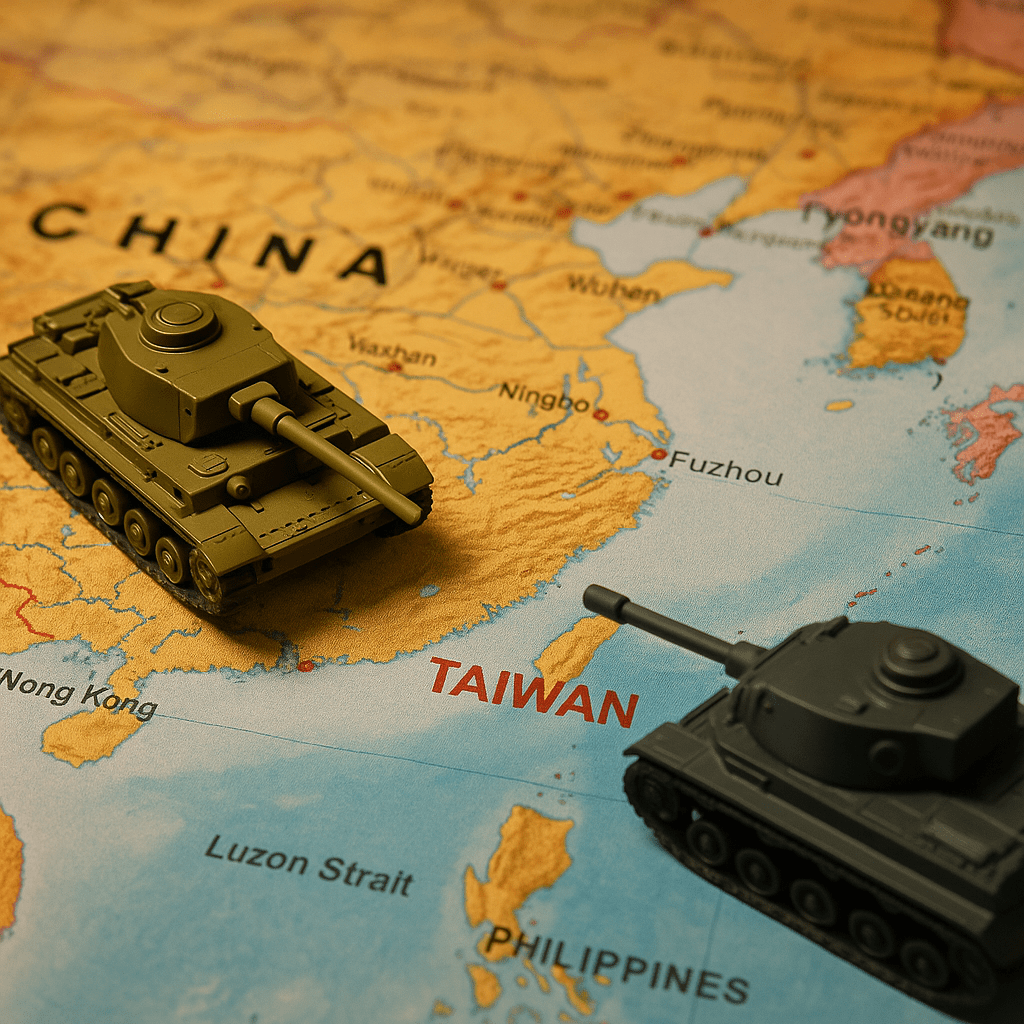
One morning in November 2021, I was watching the morning news. A well-known journalist, whose name I’ll leave out, was appearing as a guest to discuss the state of Turkish-American relations at the time. Near the end of her remarks, she briefly mentioned the growing stress along the Russian-Ukrainian border, noting that officials in Washington had begun issuing warning signals. According to her, Washington was clearly anticipating a Russian invasion of Ukraine.
I remember quite well that I shrugged off at the time, thinking she was overreacting. Russia invading Ukraine? Give me a break, I thought. That kind of thing doesn’t happen anymore. Remember Fukuyama? Prompting fear surely serves an ulterior goal. Maybe get NATO members to spend more on defense?
In the months that followed, news of the Russian buildup along the Ukrainian border gradually began to receive more public attention. However, Putin at that time kept insisting these were simple military drills, nothing more. I was not paying proper attention.
For some reason, I’m always awake when big things happen. When the U.S. eliminated Qasem Suleimani, I was awake. When a major earthquake hit eastern Turkey, I was awake. And when Russia began invading Ukraine at full-scale, I was awake.
In retrospect, I should have seen it coming. Months before the invasion, Putin had published an essay titled “On the Historical Unity of Russians and Ukrainians,” in which he talked about the artificiality of Ukrainian statehood and nationhood. Pro tip: if an article starts with “On” something, the author is not inviting debate, they’re declaring a self-evident truth. So On the Historical Unity of Russians and Ukrainians? That is not a question. That’s a conclusion: Russians and Ukrainians are historically united, period.
This brings me to my next point: However opaque or corrupt, any regime in the world stands where it stands only through the consent its people. That consent might be tacit or fervent, but it is the basis of a regime’s legitimacy. The production of consent is a structural necessity especially for authoritarian or hybrid regimes where coercion alone is unsustainable (unless you are North Korea.) In most cases, consent must be manifactured, managed and reproduced through a range of ideological and institutional mechanisms.
This compels autocracts to communicate their messaging to the broader population constantly and systematically. And more often than not, they are remarkably frank in what they say. Hitler, Lenin, Mussolini and Khomeini all told us exactly what they intended to do, often in painstaking detail, long before they actually did it. Their writings weren’t vague manifestos, they were roadmaps.
In Putin’s case, he was signaling his intentions toward Ukraine since 2014, framing the narrative around the alleged oppression of Russian speakers in eastern Ukraine, NATO’s eastward expansion, and the threat posed by a Western-oriented Ukrainian state. His article in 2021 laid out the pseudo-historical and political justifications for the invasion.
Between the publication of Putin’s essay and the onset of the invasion, Putin consistently transmitted the message that Russia’s security was under direct threat. As Russian troops amassed on the Ukrainian border, Putin’s messages aimed not only at building consent domestically, but also at shaping the terms of negotiation and bargaining with the West. I simply missed the signals.
Xi Jinping has been conveying a similar message on Taiwan for years, yet few seem to be paying attention. Since 2013, Xi Jinping has consistently been emphasizing his motto that both sides of the Taiwan Strait are one family. In his 2025 New Year’s address, he not only reiterated this message but also declared, “No one can sever our family bonds, and no one can stop the historical trend of national reunification.” This statement came just two months after Xi pledged to achieve “reunification” with Taiwan during the Chinese Communist Party’s anniversary reception.
In May 2025, Xi sent yet another signal. He published a lengthy article in the Russian Gazette, where he argued that “the historical trend toward China’s ultimate and inevitable reunification is unstoppable.” While transmitting these signals, he never struck out the use of force as an option to ensure “Chinese reunification”.
Ever since, China ramped up its military drills along the Taiwan Strait. Chinese incursions into Taiwan’s Air Defense Identification Zone have become a daily routine while Chinese Coast Guard vessels continue to intrude into restricted waters around the Kinmen Islands (TAI).
If these developments aren’t enough to ring alarm bells, the fact that China is closely studying how Russia copes with and evades Western sanctions certainly should be. Russia may be fighting in Ukraine, but China has been watching and learning since day 1. And they are not only looking at the battlefield, but also closely studying the West’s resolve. I’ve seen this movie before, and I know how it ends. The only question now is when and how it premieres.
Former CIA Director William Burns revealed in 2023 that intelligence suggests Xi has instructed China’s military to be ready for a Taiwan invasion by 2027. Then again, it’s not like the U.S. has never gets intelligence wrong… right? 2027 is also the year retired United States Indo-Pacific Command Admiral Philip Davidson hinted at for the invasion. Deputy Assistant Secretary of Defense for East Asia John Noh emphasized the same year in 2025, citing China’s unprecedented military buildup.
I can only speculate about the fixation on 2027. Perhaps it’s the year China is expected to complete its massive military buildup and will be ready to challenge U.S. power in the Indo-Pacific. Maybe it’s the point when Beijing believes the balance of power will tip in its favor in the region.
Or maybe, just maybe, it’s the year the White House flashes not a red light, but an orange one. And you know what that means.


 Notes from Blank Page
Leave a comment